Guides · definition
Concealed Pivot Hardware and Clean Sightlines
How concealed dust-proof seals and hidden hardware deliver the minimalist sightlines that drive modern pivot door selection.
Updated July 17, 2026

The Design Argument for Concealed Hardware
A hinged door announces its mechanism. Hinges, latch plates, closer arms, weather-stripping — all visible, all part of the composition whether the design wants them or not.
A pivot door with concealed hardware makes a different argument. The panel is the composition. The seals are inside the panel edges and the frame profile. The pivot bearings are recessed into the head and the floor. The closer is under the slab. The door reads as a plane and a line — the sightlines of the frame — and nothing else.
That is why concealed pivot hardware is a design decision as much as an engineering one. For minimalist modern architecture, it is what makes the pivot line belong in the composition.
What “Concealed” Actually Means
Three engineering choices, working together.
Concealed dust-proof top and bottom seals. The seals sit inside the panel and frame profile, compressing against a mating surface when the door is closed. Nothing is visible from either face. Air and dust are sealed out; the sightline is unbroken.
Concealed pivot bearings. The top bearing is recessed into the door head. The bottom bearing is set into the sub-floor cement-case closer. Nothing protrudes above the finished floor or below the finished ceiling.
Concealed multi-point locking (on entry-configured pivots). Multi-point locking runs through the panel edge, engaging at multiple points around the perimeter when the door is closed. No visible strike plates, no protruding latches.
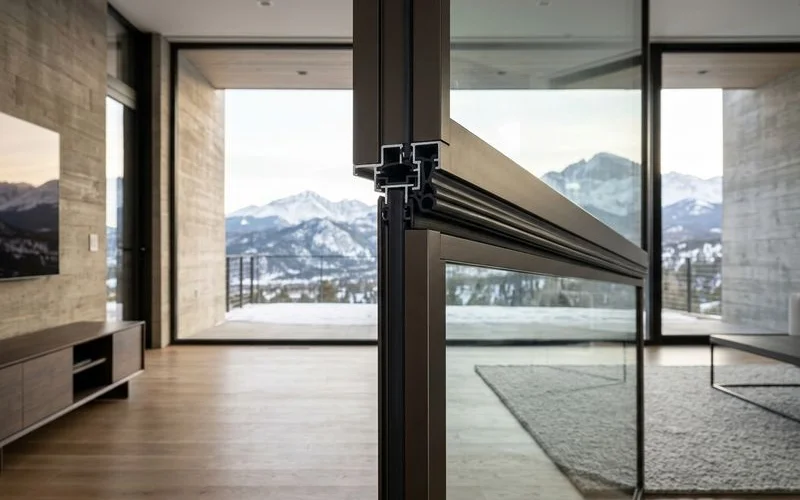
The finished door reads as a single plane with a thin frame perimeter. Everything mechanical is behind that plane.
Sightlines Over Time
The visual argument for concealed hardware is obvious the day of install. The argument for it over time is quieter and more important.
Exposed hinges wear. The finish rubs where the pin turns. The paint chips where the leaf meets the frame. After ten years, a hinged door’s mechanism reads its history on its face.
Concealed pivot hardware has no visible wear surface. The pivot bearings turn inside the head and the sub-floor case. The seals compress against mating surfaces inside the profile. The panel face — the plane the design cares about — never accumulates wear from the mechanism. At year twenty, the door still reads as it did on day one.
That is why concealed hardware belongs to a design language that expects the architecture to age well.
Sightlines Across the Project
The minimalist sightline argument extends across the whole project. Concealed hardware on the pivot door coordinates with narrow-frame sliding glass walls, thin-profile architectural windows, and matching concealed hinges on premium hinged entries. The whole envelope reads with the same visual restraint.
For a modernist Colorado custom home, that consistency is often what carries the architecture. Every opening speaks the same visual language, and none of them announce their hardware. Read choosing finishes and configurations for how the sightline decision coordinates with panel style and finish.
Maintenance Reality
The dust-proof seals are engineered for long life and are field-serviceable if replacement is ever needed. The pivot bearings are lubricated for life on standard configurations. The sub-floor closer is accessible under a small floor plate for service without lifting the panel.
Concealed hardware isn’t inaccessible hardware. It is hardware whose access is deliberate — hidden in daily use, available for service when service is due.
The design consultation walks through the concealed-hardware specification for the project’s context. Standard configurations on the pivot line already include the concealed dust-proof seals, concealed bearings, and (for entry-configured pivots) concealed multi-point locking.
FAQ
Related Questions
Is the hardware visible?
The pivot bearings, dust-proof seals, and closer mechanism are concealed inside the panel, head, and floor. Only the panel face is visible in the finished door — no exposed hinges, no visible track, no surface-mounted hardware.
Why do sightlines matter?
Minimal frames and concealed hardware keep the focus on the door as a plane and on the architecture around it, not on the mechanism. For modernist and minimalist design languages, sightlines are the design.
Do concealed seals need maintenance?
The dust-proof seals are engineered for durability and are field-serviceable if replacement is ever needed — but the design intent is long-term maintenance-free operation.
Continue Reading
Related Guides
scenario
Oversized and Custom Pivot Door Configurations
Panel size limits, custom dimensions and glass, pivot-adjacent configurations, and hardware for heavy panels on statement Colorado entrances.
process
Pivot Door Finishes, Glass, and Design Styles
Navigate 29 pivot design styles, 12+ designer finishes, and custom glass — and how to coordinate finishes across a Colorado project.
scenario
Pivot Doors in Colorado's High-Altitude, Freeze-Thaw Climate
How pivot doors perform through Colorado freeze-thaw — thermal break performance, seal integrity, snow and wind at the entrance, and UV-stable finishes.
comparison
Pivot Doors vs. Traditional Hinged Entry Doors
Weigh the signature pivot look against conventional hinged entries — operation, size capability, cost, design trade-offs, and sightlines.
The Collection
Learn more about Pivot Doors
Explore the full product line and request a design consultation to translate this reading into a specification for your project.