Guides · process
Pivot Door Finishes, Glass, and Design Styles
Navigate 29 pivot design styles, 12+ designer finishes, and custom glass — and how to coordinate finishes across a Colorado project.
Updated July 17, 2026
Style Is a Composition Question
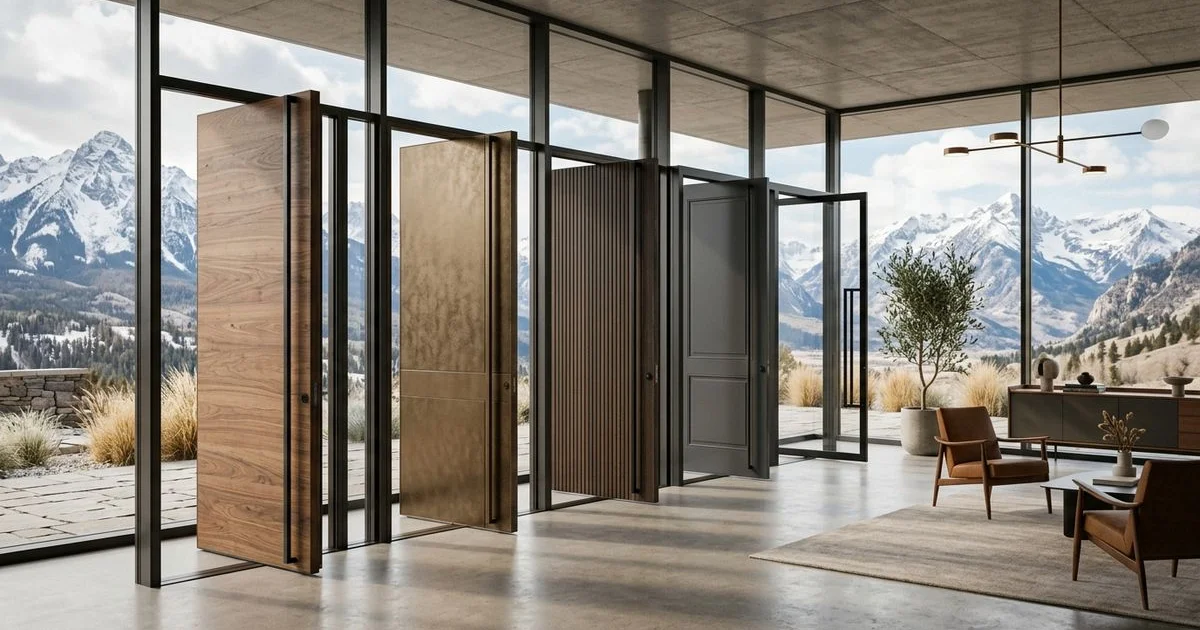
Every entrance sits inside a facade composition. The panel style, glass, and finish of a pivot door either match that composition or fight it. Alta Vetro’s pivot line offers 29 design styles across 12+ designer finishes precisely so the entrance can be tuned to the architecture rather than compromised to it.
The choice isn’t decorative. A flush minimalist pivot with metallic champagne finish reads editorial and modernist. A sculpted contemporary pivot in matte black reads structural and monolithic. A wood-grain pivot with reeded glass reads warm-modern for mountain-modern architecture. Each combination belongs to a specific design vocabulary. Before settling on a finish, it’s worth understanding what a pivot door is and how it works, because the mechanism is what lets these styles scale to statement sizes.
The Twenty-Nine Pivot Design Styles
The pivot line groups roughly into four families of design styles:
Flush minimalist. A single unbroken plane, no articulation, no visible hardware. The door reads as sculpture. Common on contemporary modernist facades where any panel articulation would fight the language.
Linear articulated. Horizontal or vertical grooves, banded articulation, or subtle rebate detailing. Reads mid-century modern or contemporary. Adds visual scale without breaking the minimalism.
Sculpted contemporary. Panel contours, faceted planes, or textured surfaces that give the door a distinct sculptural presence. Reads editorial. Common on statement modernist entrances where the door is the composition anchor.
Custom bespoke. Panels drawn to the architect’s specification for one-off entrances. Configuration is per project.
The pivot doors hub walks through the full range.
The Twelve Designer Finishes (Plus Custom)
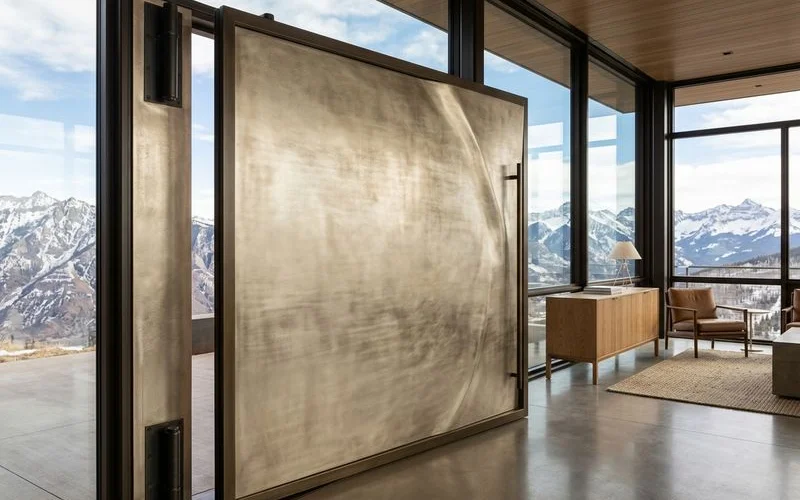
The standard finish palette covers most of the palette decisions a modern Colorado build will need. Notable options include:
- Obsidian matte black — the anchor. Reads structural and disappears into thin sightlines.
- Graphite grey — softer than black, more warmth, holds the modern language.
- Metallic champagne — the brand’s signature. Editorial, reflective, quiet luxury.
- Pearl bronze — a warm neutral with more presence than a matte.
- Deep bronze and warm graphite — mid-tones for palettes that need more depth.
- Wood-grain textures — several tones from oak-like to walnut-like, engineered UV-durable for altitude.
- Pearl white and soft neutrals — for palettes where the door is meant to recede.
Custom colors are matched to RAL or the architect’s bespoke color. Powder-coat and anodized finishes both accept custom color; the durability spec is the same as the standard palette.
Glass Options
Glass on a pivot door works alongside the panel style. A flush minimalist panel with clear glass reads modernist and view-forward. The same panel with reeded glass reads private and editorial. A sculpted contemporary panel with fluted glass adds textural depth to the composition.
Standard glass options include clear low-E insulated glass units (specified for altitude — see the high-altitude glazing guide), fluted and reeded architectural glass, bronzed and tinted glass, and custom textured or patterned glass. On oversized configurations, the glass is spec’d to the panel size and altitude conditions.
Coordinating the Palette Across the Project
The design consultation walks through the entire project’s finish palette, not just the pivot door. When premium entry doors, architectural windows, sliding walls, and pivot entries are on the same specification, the finish, hardware, and glass all coordinate.
Matching a matte black pivot to a matte black window frame. Coordinating the champagne finish across an entry-panel accent and a hardware pull. Continuing the wood-grain texture on the exterior door and window trim assembly. These are the small consistencies that make the project read as a coordinated whole rather than a set of independent decisions.
Where to Start
For an architect or homeowner narrowing pivot design options, the design consultation covers the finish palette and design style walkthrough with sample material in hand. The catalog of 29 styles and 12+ finishes narrows quickly once the architectural context is on the table.
From there, glass, hardware, and configuration are settled in the same session, and the specification package follows.
FAQ
Related Questions
How many pivot styles are there?
Twenty-nine pivot design styles run from minimalist flush panels to sculpted contemporary contours, giving the entrance a specific architectural language to match the facade.
Can finishes be matched across a home?
Yes. The 12+ designer finish palette runs across pivot doors, entry doors, sliding walls, and windows, so finishes coordinate across the project — inside and out.
Is custom glass available on pivots?
Yes. Clear, fluted, reeded, bronzed, textured, and fully custom architectural glass are all available on pivot doors.
Continue Reading
Related Guides
definition
Concealed Pivot Hardware and Clean Sightlines Explained
How concealed dust-proof seals and hidden hardware deliver the minimalist sightlines that drive modern pivot door selection.
scenario
Oversized and Custom Pivot Door Configurations
Panel size limits, custom dimensions and glass, pivot-adjacent configurations, and hardware for heavy panels on statement Colorado entrances.
scenario
Pivot Doors in Colorado's High-Altitude, Freeze-Thaw Climate
How pivot doors perform through Colorado freeze-thaw — thermal break performance, seal integrity, snow and wind at the entrance, and UV-stable finishes.
comparison
Pivot Doors vs. Traditional Hinged Entry Doors
Weigh the signature pivot look against conventional hinged entries — operation, size capability, cost, design trade-offs, and sightlines.
The Collection
Learn more about Pivot Doors
Explore the full product line and request a design consultation to translate this reading into a specification for your project.