Guides · process
Choosing Finishes, Glass, and Configurations
A calm guide through Alta Vetro's 70+ door designs and 12+ finishes, custom glass and dimensions, and what a design consultation covers.
Updated July 17, 2026
Configuration Is the Point
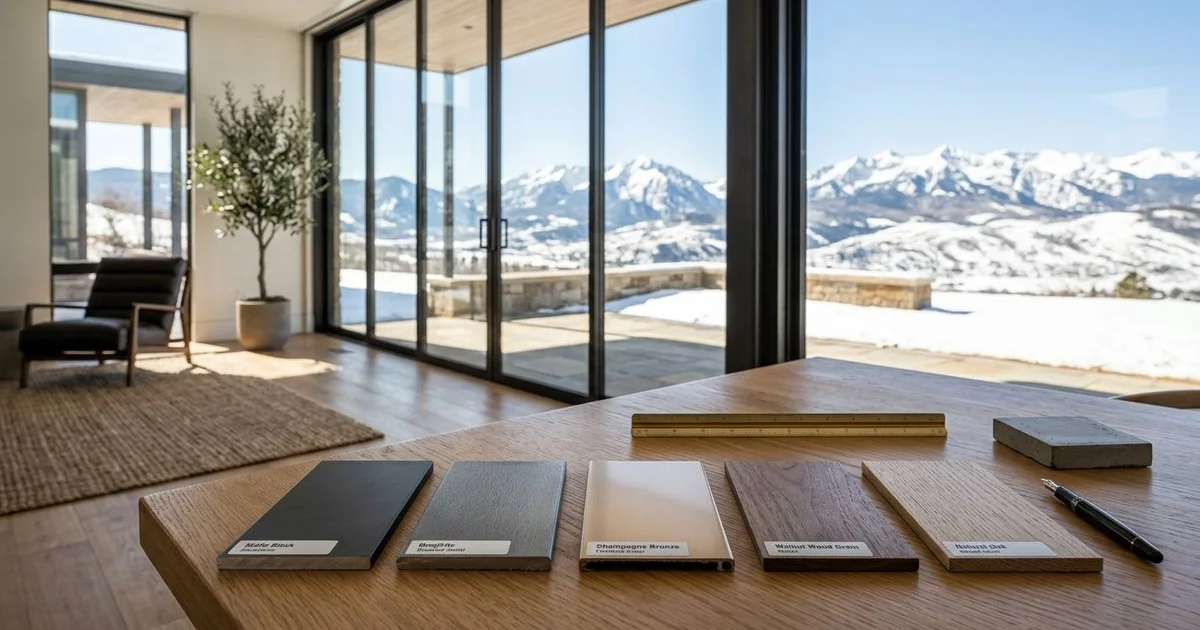
Alta Vetro doesn’t sell doors and windows off a catalog page. The line offers 70+ door design styles and 12+ designer finishes plus custom colors, and every specification is configured to the project — panel dimensions, glass, hardware, threshold detail. That configurability is the point, and it is also the reason the design consultation is where the specification actually takes shape.
The consultation isn’t a sales call. It is a working session where the architecture, the material palette, and the openings the design calls for are walked through, and the door and window specification lands from that walkthrough. Here is how the choices break down.
Panel Design Styles
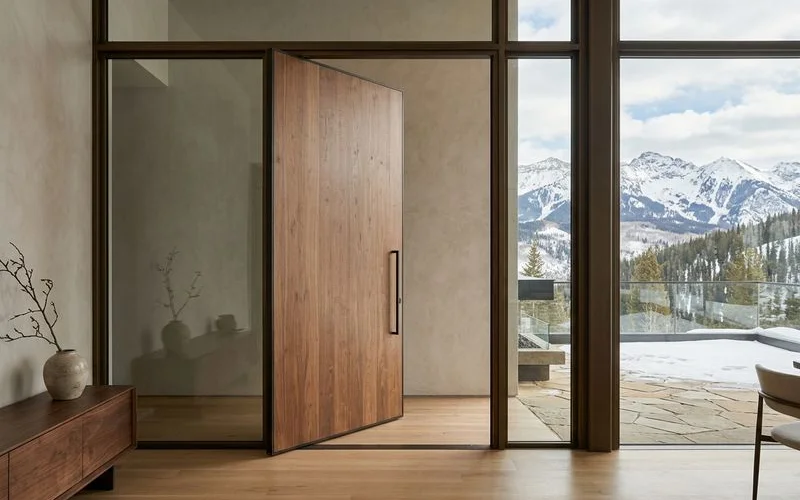
Panel style is where the entrance’s architectural language shows up. Alta Vetro’s 40+ premium entry door styles and 29 pivot styles run from flush minimalist — a single unbroken plane, the door as sculpture — through mid-century linear articulation to contemporary sculpted contours.
Match the panel style to the architecture. A flush minimalist door reads correctly with a modern-minimalist facade; a sculpted contemporary door with an architecturally expressive one. Wood-grain textures work in a mountain-modern or transitional context; anodized metallic finishes work in urban modernist and contemporary designs.
The 12 Designer Finishes (and Custom Colors)
The standard finish palette covers most of the color decisions a design will need:
- Obsidian matte black — the anchor finish. Reads structural and disappears into thin sightlines.
- Graphite grey — softer than black, holds the modern language with more warmth.
- Metallic champagne — the brand’s signature accent. Reads editorial and reflects daylight.
- Pearl bronze — a warm neutral with more presence than a matte.
- Wood-grain textures — several tones from oak-like to walnut-like, engineered for altitude UV.
- Additional metallics and neutrals — pearl white, deep bronze, warm graphite, and further tones to round the palette.
Custom colors are available on request. If the architect has a bespoke color already specified into the facade palette, we match it in powder-coat or RAL and coordinate finish across doors and windows on the same project.
Glass and Sightlines
Glass is where privacy, daylight, and thermal performance intersect.
Clear glass is the default for view-driven openings. Pair with low-E and altitude-appropriate IGU spec (see the high-altitude glazing guide).
Fluted and reeded glass give privacy without giving up daylight. Common on entries where the door needs to admit light but not sightlines from the street.
Bronzed glass carries warmth and reads editorial. Useful in south-facing openings where solar gain is a design concern and the tint moderates the interior color temperature.
Custom glass is available for non-standard architectural requirements — textured, patterned, structural, insulated with specific coating packages. Configuration is per project.
Configuration Decisions Across the Project
Beyond the individual door or window, the design consultation coordinates finish, hardware, and glass across all openings on the project. A house isn’t a set of independent doors and windows; it is a coordinated system. Alta Vetro’s specification pathway is built around that coordination.
- Finish coordination — the same 12+ designer finish palette runs across pivot doors, entry doors, sliding walls, bi-fold walls, and architectural windows, so the finishes match across the project.
- Hardware coordination — concealed vs exposed hinges, matching handle pulls, multi-point locking on entries, integrated locks and pulls on moving glass walls.
- Glass package coordination — the low-E, altitude, and thermal spec is set once for the project and applied across all openings.
What the Design Consultation Covers
A working design consultation typically covers:
- Review of the architecture — plans, elevations, and design intent
- Panel styles and finishes — walked through with the sample palette, selections narrowed
- Glass and IGU spec — including altitude and code considerations
- Configuration decisions — panel dimensions, opening arrangements, threshold detail
- Specification package outline — BIM families, section drawings, NFRC values, install coordination
One to two working sessions is usually enough to settle the specification for a single-residence project. Larger commercial or multi-residence projects run longer. From there, the specification package is prepared and the order is placed.
The consultation is where near-limitless configurability turns into a specification that fits the project, the schedule, and the budget. It is where the project starts.
FAQ
Related Questions
How many finishes are available?
Twelve designer finishes come standard across the door and window lines — matte black, graphite grey, metallic champagne, pearl bronze, wood-grain textures, and more — plus custom colors on request.
Can I get custom glass and dimensions?
Yes. Custom glass — clear, fluted, reeded, bronzed — and custom dimensions are core to the offering. Oversized configurations are part of the standard configuration menu.
What happens in a design consultation?
The consultation walks through the architecture, finishes, glass, hardware, and configuration for the project. Panel sizes and material palette are settled together, and the specification package flows from there.
Continue Reading
Related Guides
decision stage
Architect & Builder Specification Resource Guide (BIM, CSI, NFRC)
A specification hub for architects and GCs — BIM/Revit families, CSI Division 08 references, NFRC certification framing, and installation coordination.
definition
High-Altitude Glazing Physics: Engineering Glass for the Colorado Rockies
How altitude changes glass specification in the Colorado Rockies — capillary breather tubes, pressure equalization above 8,000 ft, UV, and freeze-thaw cycling.
definition
Thermally Broken Aluminum, Explained for Colorado Climates
How the thermal break stops bridging and condensation — polyamide struts, freeze-thaw performance, and why it matters for Colorado energy codes and comfort.
decision stage
Why Manufacturer-Backed Installation Matters
Why separating supply from certified, product-familiar installation is the make-or-break risk on high-end architectural glass — and how Alta Vetro's partnership solves it.