Guides · definition
Thermally Broken Aluminum, Explained for Colorado Climates
How the thermal break stops bridging and condensation — polyamide struts, freeze-thaw performance, and why it matters for Colorado energy codes and comfort.
Updated July 17, 2026
Why the Frame Is a Thermal Question
Glass gets most of the thermal attention in an insulated glazing package. But the frame is where a lot of thermal performance is quietly won or lost. Aluminum is roughly 1,000 times more thermally conductive than glass. A frame with no insulating break in it is a highway for heat to leave the room in winter and enter it in summer — and, more visibly in Colorado’s climate, a surface cold enough that condensation forms on the interior face.
Thermally broken aluminum is the specification answer. It is what makes an aluminum frame profile — slim, strong, and paired with narrow-frame sightlines — actually perform on a mountain build. All Alta Vetro premium door and window series are thermally broken. Here is why that matters.
What the Thermal Break Actually Is
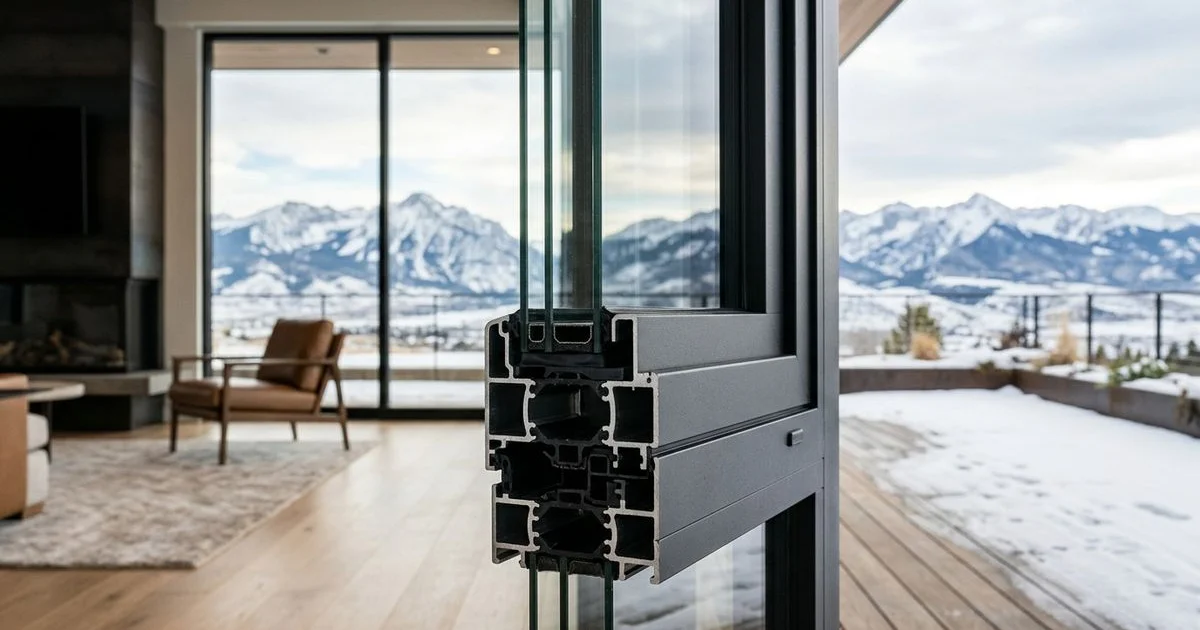
A thermally broken aluminum frame is a two-part assembly. An outside aluminum profile and an inside aluminum profile are mechanically connected by an insulating strut — usually polyamide, occasionally polyurethane on specific series — that runs the full length of the profile.
The polyamide strut has thermal conductivity roughly two orders of magnitude lower than aluminum. It carries the mechanical load between the inside and outside profiles, but it does not carry heat between them. The result: the outside profile can be at –10°F and the inside profile can be near room temperature, with the strut acting as an insulating bridge in between.
That’s the mechanism. The rest is what it enables.
Condensation and Comfort at the Frame Edge
The most immediate benefit shows up in the room. A non-thermally-broken aluminum frame in a Colorado winter drops well below the interior dew point of the room’s air. Condensation forms on the interior frame face — usually along the sill or the bottom of the mullion. Over time, that condensation causes finish damage, mold, and warranty conversations.
A thermally broken frame keeps the interior surface temperature well above the dew point in typical winter interior conditions. Frost outside, no water on the sill inside. The frame edge stays comfortable to touch. Comfort at the frame edge is the difference between a room that reads as well-insulated and a room that reads as drafty even when the thermostat is holding.
IECC Energy Code Compliance
Colorado’s IECC amendments in mountain counties require frame-plus-glass U-factor performance that is difficult to hit without a thermal break. Even with an aggressive glass specification — triple-pane, low-E, argon-filled — a non-thermally-broken aluminum frame degrades the whole-assembly U-factor to the point where the opening can’t clear the code target.
Thermally broken framing changes that. The whole-assembly U-factor — center of glass plus frame — comes into the range where the specification can meet or exceed IECC. Architects working with our specification support pack (see the architect and builder resource guide) get the frame U-factor values needed to run the compliance calculation.
Freeze-Thaw Performance and Seal Longevity
Colorado’s mountain climate cycles across freezing daily through most of the winter. A frame that expands and contracts with temperature — as all aluminum frames do — puts stress on the seals every cycle. Standard aluminum frames go through larger absolute temperature swings on both faces than thermally broken frames do, because the whole aluminum mass moves with the outside temperature.
Thermally broken frames damp that cycling. The inside face moves less, the outside face moves as it must, and the polyamide strut absorbs the differential without transferring mechanical stress across the assembly. The result is longer seal life, less air leakage over time, and a frame that still performs at year twenty the way it performed at year one.
Why Not Wood or PVC?
Two questions come up in every design consultation about material choice.
Wood is warm and beautiful. It also requires ongoing maintenance — refinishing, weatherstripping replacement, hardware alignment — that clients often underestimate. It doesn’t hold the ultra-narrow frame sightlines modern architecture asks for. And in the freeze-thaw cycling of the Colorado mountains, wood frames need more service than aluminum does.
PVC performs thermally but compromises the frame profile. The sections are thicker to carry the same structural load. The aesthetic reads differently. And on large-format doors and windows, PVC’s structural limits become a constraint the architect has to design around.
Thermally broken aluminum keeps the minimalist architectural language — thin frames, clean sightlines, custom finishes — and delivers the thermal performance the mountain climate requires. It is why it is standard across the entry door and architectural window lines, and across the premium sliding and bi-fold series.
FAQ
Related Questions
What is a thermal break?
A thermal break is an insulating barrier — usually a polyamide strut — placed inside an aluminum frame to stop heat from transferring directly from the outside frame face to the inside frame face. It turns the frame into a two-part assembly with a low-conductivity connector between.
Does it prevent condensation?
It reduces internal condensation by keeping the interior frame surface warmer than the interior dew point. Standard aluminum without a thermal break can drop below dew point in Colorado winter conditions, which is when condensation forms.
Why aluminum instead of a warmer material?
Thermally broken aluminum pairs slim, strong sightlines with insulated performance. Wood is warm but softer and requires more upkeep; PVC compromises the frame profile. Thermally broken aluminum keeps the minimalist architectural language without giving up thermal performance.
Continue Reading
Related Guides
decision stage
Architect & Builder Specification Resource Guide (BIM, CSI, NFRC)
A specification hub for architects and GCs — BIM/Revit families, CSI Division 08 references, NFRC certification framing, and installation coordination.
definition
High-Altitude Glazing Physics: Engineering Glass for the Colorado Rockies
How altitude changes glass specification in the Colorado Rockies — capillary breather tubes, pressure equalization above 8,000 ft, UV, and freeze-thaw cycling.
process
How to Choose Finishes, Glass, and Configurations for Your Project
A calm guide through Alta Vetro's 70+ door designs and 12+ finishes, custom glass and dimensions, and what a design consultation covers.
decision stage
Why Manufacturer-Backed Installation Matters
Why separating supply from certified, product-familiar installation is the make-or-break risk on high-end architectural glass — and how Alta Vetro's partnership solves it.