Guides · definition
Casement and Crank-Out Aluminum Windows Explained
How casement and crank-out aluminum windows work — operation, sealing, ventilation, narrow-frame aesthetics, and where they fit in modern homes.
Updated July 17, 2026
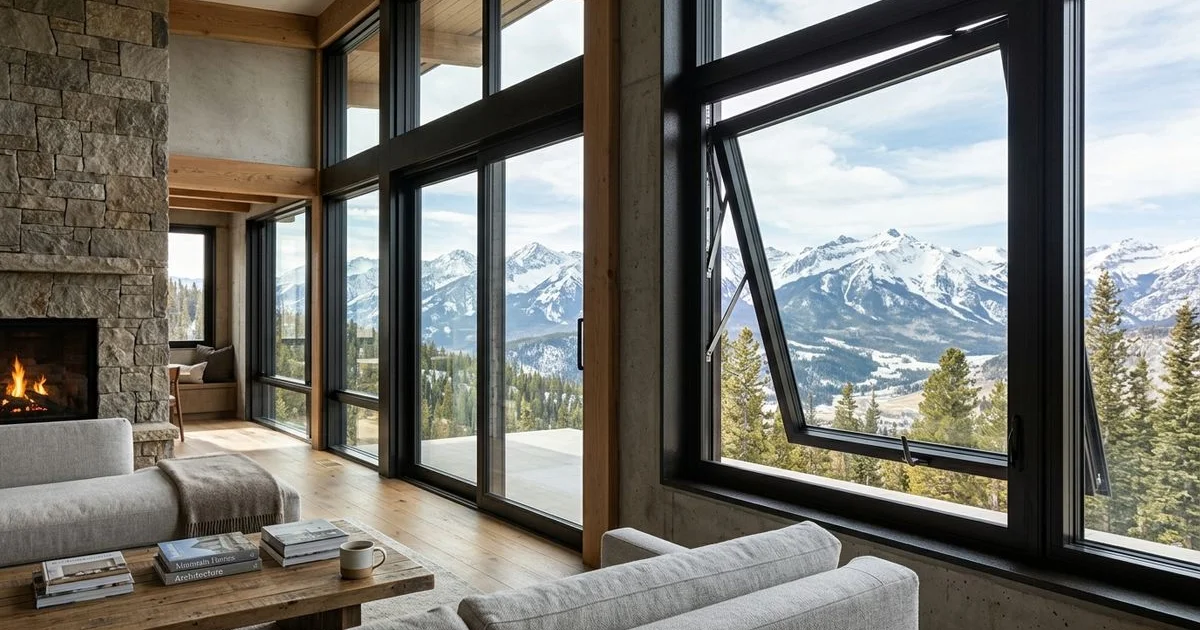
The Casement Mechanism
A casement window is a hinged sash. The hinge runs vertically along one side of the sash (side-hung), and the sash swings outward from the opposite edge. A crank mechanism inside the frame drives the sash’s opening and closing motion — turn the handle, the sash swings outward or pulls back into the frame.
When closed, the sash pulls tight against the frame perimeter for full-perimeter compression sealing. This is what gives casement windows their reputation for excellent sealing performance — the perimeter seal is under active compression when the sash is latched, not just resting against a stop.
The Alta Vetro architectural window line includes casement configurations across the thermally broken aluminum, passive-house-grade, and narrow-frame series.
Why Casement Sealing Is Superior
Compared to sliding, double-hung, or single-hung windows, casement windows have a specific sealing advantage.
Sliding windows seal against a fixed stop when closed. The seal is not actively compressed — it’s held against the stop by the sash’s own weight and the closure hardware. Over time, seals wear and the sash may not consistently compress against the stop.
Double-hung and single-hung windows rely on weatherstripping between the sash and the frame runners. The weatherstripping wears at the friction points; sealing degrades over time.
Casement windows pull the sash into the frame with the crank mechanism, actively compressing the perimeter seal. The compression is uniform around the sash perimeter. There’s no reliance on gravity or friction to hold the seal.
For a Colorado mountain home where wind-driven rain and driving snow are seasonal realities, the casement seal is what handles the exposure. The architectural window hub covers the sealing performance across the line.
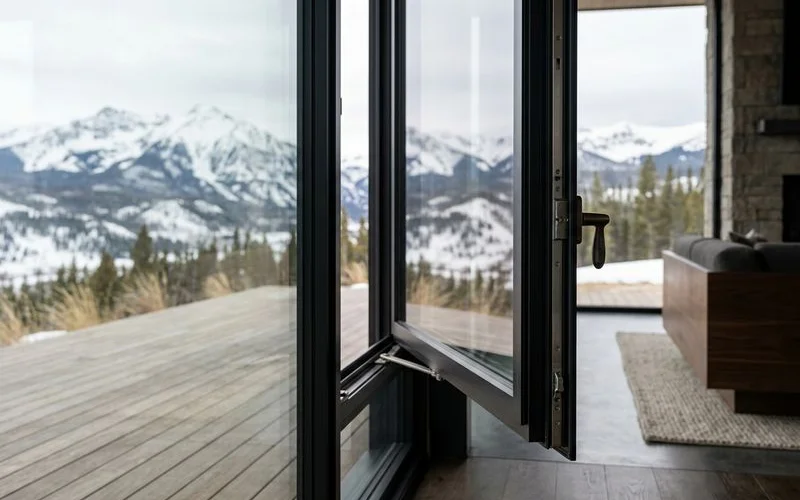
Ventilation
Casements are excellent for ventilation because when open, they capture prevailing wind across the whole sash area.
Compare with a sliding window: at half-open, only half the window area admits airflow. At full-open, still only half (the other half is the closed panel behind).
A casement at half-open catches prevailing wind across its full sash area, angled to redirect the flow inward. At full-open (perpendicular to the wall), the whole sash area is available for airflow.
For rooms where ventilation is a design priority — kitchens, master bedrooms, primary living areas — casement configurations are often the recommendation.
Narrow-Frame Aesthetics
The visible aluminum on a well-designed casement window is minimized:
- Sash frame: The aluminum perimeter around the glass is slim, typically 30-40mm on the narrow-frame line
- Frame: The visible frame around the whole opening is similarly slim
- Hardware: The crank mechanism is concealed inside the frame — no exposed operators, just a discreet handle
The result is a window that reads as almost all glass, with a thin dark line around the perimeter. For modernist architecture where minimizing visible framing is a design goal, narrow-frame casements support the language directly.
Crank-Out (Awning) Configurations
A crank-out awning window is mechanically similar to a casement — a crank mechanism opens the sash outward — but the hinge runs horizontally along the top of the sash instead of vertically along the side. The sash swings outward from the bottom edge, creating an awning-like projection.
Awning configurations are useful where the window opens at a location that requires horizontal-hinged operation — high on a wall, in a stairwell, above a countertop or built-in — or where the design vocabulary favors horizontal opening motion.
Both casement and awning configurations share the same compression-seal advantage and the same crank hardware family.
Where Casement Fits Architecturally
Casement windows fit multiple architectural languages:
Modernist and contemporary architecture. Narrow-frame casements read as thin aluminum lines around glass, consistent with the design vocabulary.
Passive House and high-performance projects. The compression-seal performance and single-sash configuration make casements a common choice for passive-house-grade specifications (see the passive-house-grade windows guide).
Mountain-modern and warm-modern. The crank operation and outward swing complement the openness these languages value.
Traditional and transitional. Traditional casement configurations with more articulated frame proportions fit heritage-modern and transitional design vocabularies.
Across all languages, the casement is a well-suited configuration when compression sealing, wind exposure, and ventilation are considerations.
Where Casement Isn’t the Default
For rooms where the window opens into a heavily-trafficked exterior space (a small deck, a narrow walkway), the outward projection of an open casement can be awkward. Fixed windows or awning configurations may be preferable.
For openings where a large single sash exceeds the crank hardware’s design capacity, multiple casements grouped together may be the specification, or a different window configuration (large fixed with operable ventilator, for example) may be considered.
The design consultation walks through the configuration choice against the specific opening and room use. The architectural window hub covers the full product line context, and the double-pane vs. triple-pane glazing guide covers the glass specification decisions for altitude and thermal performance.
FAQ
Related Questions
How does a casement window operate?
A casement window opens outward on a hinge running vertically along one side of the sash. A crank mechanism inside the frame drives the sash to open and close. When closed, the sash pulls tight against the frame perimeter for a full compression seal.
Are casements good for ventilation?
Yes. When open, casement windows can capture prevailing wind across the whole sash area, delivering excellent ventilation. The opening angle can be tuned from a slight crack to nearly perpendicular to the wall.
Do they have slim frames?
The Alta Vetro narrow-frame casement series has slim aluminum profiles that maximize glass area. The visible aluminum on the sash edge and frame perimeter is minimized while preserving structural performance.
Continue Reading
Related Guides
comparison
Double vs. Triple-Pane and Low-E Glass for High-Altitude Homes
Choose glazing for mountain performance — double vs triple-pane trade-offs, low-E coatings, argon fill, U-factor/SHGC, and altitude-specific IGU considerations.
scenario
Engineering Windows for Snow Load, UV, and Temperature Swings
How windows are engineered for Colorado — snow-load resistance, high-altitude UV protection, temperature-swing performance, and capillary breather tubes.
definition
Passive-House-Grade Windows for Colorado Mountain Homes
Passive-house-grade window performance for Colorado — thermal break, multi-cavity insulation, energy efficiency in extreme climates, and condensation resistance.
The Collection
Learn more about Architectural Windows
Explore the full product line and request a design consultation to translate this reading into a specification for your project.