Guides · definition
Passive-House-Grade Windows for Colorado Mountain Homes
Passive-house-grade window performance for Colorado — thermal break, multi-cavity insulation, energy efficiency in extreme climates, and condensation resistance.
Updated July 17, 2026
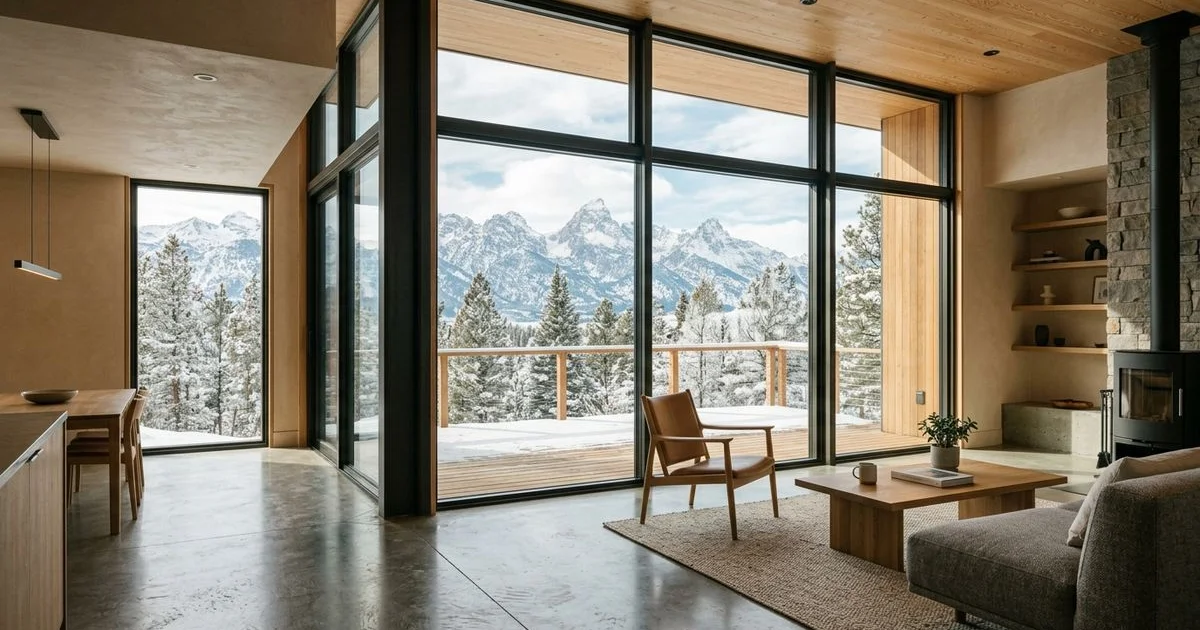
Passive House, and What Windows Have to Do
The Passive House standard is a rigorous voluntary energy standard originally developed in Germany and adopted internationally through PHI (Passive House Institute) and PHIUS (Passive House Institute US). A certified Passive House building uses roughly 90% less heating energy than a code-compliant building of the same size and climate.
Windows are one of the biggest thermal envelope elements in a Passive House specification. To hit the whole-building energy target, windows have to hit specific performance criteria: U-factor typically 0.13 or lower (whole-assembly), airtightness at demanding levels, and installation detailing that supports the airtight envelope.
Alta Vetro’s architectural window line includes a passive-house-grade series specified for exactly this application. Here’s how it works.
What Passive-House-Grade Actually Requires
For a certified Passive House, the specific window performance requirements depend on climate zone and orientation. In Colorado’s cold climate:
- Whole-assembly U-factor: 0.13 or lower on many specifications, and sometimes as tight as 0.10 for demanding certifications
- Air infiltration: 0.3 cfm/ft² at test pressure or lower, with the frame and installation combining for airtight envelope integration
- SHGC: Tuned to orientation — high SHGC on south for winter solar gain, low SHGC on east/west/north to minimize cooling loads
- Certified frame installation detail: The window installation into the wall assembly must integrate with the airtight envelope without cold-bridging
These targets are demanding. Standard commodity aluminum windows don’t meet them. Standard high-performance vinyl or wood windows can meet U-factor targets but often struggle with the airtightness detailing.
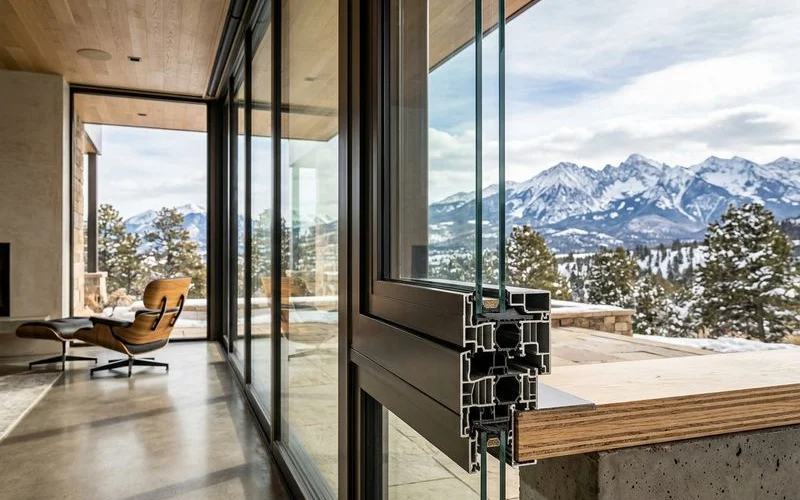
How the Alta Vetro Passive-House Series Achieves It
The Alta Vetro passive-house-grade window series is engineered for these specifications:
Multi-cavity thermally broken frame profile. The frame construction is deeper than standard windows — approximately 90-95mm frame depth — to accommodate the multi-cavity insulation and thermal break required for target U-factor. Multiple internal chambers, each contributing to the whole-assembly thermal performance, work together to hit the demanding U-factor.
Triple-pane insulated glass with two low-E coatings. The glass specification is triple-pane insulated glass — two IGU cavities filled with argon or krypton — with low-E coatings on the interior surface of each exterior pane. This achieves the low center-of-glass U-factor the assembly requires.
High-performance edge seals. The IGU edge seal specification uses warm-edge spacers and enhanced primary and secondary seals to preserve the argon or krypton fill over the assembly’s design life.
Airtight installation detail. The frame perimeter installation into the wall assembly uses factory-provided EPDM sealing tape or specification-approved airtight membrane detail. The airtightness is achieved at the frame-to-rough-opening interface, not just at the window itself.
Whole-Assembly Performance in Extreme Colorado Conditions
At Colorado’s mountain-county elevations, the passive-house-grade window series performs in extreme conditions:
- –20°F outside, 68°F inside: The multi-cavity thermal break keeps the interior frame surface at approximately 55-60°F, well above the interior dew point.
- Heavy snow load on the sill: The frame construction resists deformation under snow-drift loading.
- High-altitude UV: UV-durable finish specifications hold their tone at altitude.
- High-altitude IGU stability: Capillary breather tubes on IGUs specified for altitude (see high-altitude glazing physics) preserve the argon or krypton fill through the pressure differential of altitude installation.
Cost and Comparison
Passive-house-grade specifications carry a premium over standard high-performance windows. The frame construction is more sophisticated, the glass is triple-pane rather than dual-pane, and the installation detailing is more demanding.
For projects targeting Passive House certification, the specification is not optional — the whole-building energy target requires the window performance. For projects targeting high performance without Passive House certification, the standard thermally broken aluminum window series often provides sufficient performance at lower cost.
The design consultation walks through the choice against the project’s energy goals.
Where Passive-House-Grade Belongs
Three project types typically justify passive-house-grade windows:
Certified Passive House projects. The specification is required for certification. No substitute.
High-performance non-certified projects. Homes targeting extremely low heating loads (net-zero, near-net-zero, or high-net-zero-plus specifications) benefit from the passive-house-grade window performance even without formal certification.
Extreme-cold-climate custom projects. Boulder-area foothill homes, Aspen-area high-elevation estates, or Steamboat-area deep-cold locations may specify passive-house-grade windows for the comfort-and-longevity benefits even when energy goals don’t require them.
For the specific project, the design consultation covers whether the passive-house-grade series is the right specification or whether the standard thermally broken architectural window line provides sufficient performance at a lower price point.
What This Delivers
For a client in a passive-house-grade Colorado home, the specification means a house that maintains comfort in extreme conditions with minimal heating energy, windows that don’t accumulate condensation on the interior face, and a frame installation that supports the airtight envelope the whole-building energy target requires.
The engineering is what makes the specification real. The thermally broken aluminum principle applies at every scale, and at the passive-house-grade series, the principle is pushed to its performance limit.
FAQ
Related Questions
What is passive-house grade?
Passive House is a rigorous voluntary standard for energy-efficient building performance. Passive-house-grade windows meet demanding U-factor targets (typically 0.13 or lower) and airtightness requirements that support the whole-building energy targets.
Do aluminum windows achieve passive-house grade?
Yes. Thermally broken, multi-cavity aluminum windows with triple-pane low-E glazing can reach passive-house-grade performance. The construction is more sophisticated than standard aluminum windows, but the material can achieve the target.
Will they resist condensation?
Yes. The multi-cavity thermally broken construction keeps the interior frame face well above dew point even in extreme Colorado winter conditions. Interior condensation on the frame doesn't form.
Continue Reading
Related Guides
definition
Casement and Crank-Out Aluminum Windows Explained
How casement and crank-out aluminum windows work — operation, sealing, ventilation, narrow-frame aesthetics, and where they fit in modern homes.
comparison
Double vs. Triple-Pane and Low-E Glass for High-Altitude Homes
Choose glazing for mountain performance — double vs triple-pane trade-offs, low-E coatings, argon fill, U-factor/SHGC, and altitude-specific IGU considerations.
scenario
Engineering Windows for Snow Load, UV, and Temperature Swings
How windows are engineered for Colorado — snow-load resistance, high-altitude UV protection, temperature-swing performance, and capillary breather tubes.
The Collection
Learn more about Architectural Windows
Explore the full product line and request a design consultation to translate this reading into a specification for your project.