Guides · comparison
Double vs. Triple-Pane and Low-E Glass for High-Altitude Homes
Choose glazing for mountain performance — double vs triple-pane trade-offs, low-E coatings, argon fill, U-factor/SHGC, and altitude-specific IGU considerations.
Updated July 17, 2026
The Glazing Specification Question
For a Colorado mountain-home window package, the glazing specification is one of the biggest levers on cost, thermal performance, and long-term durability. Double-pane or triple-pane. Low-E coating type. Argon or krypton fill. Altitude-specific IGU details.
Each choice has trade-offs. Each choice matters at the site the specification will actually be installed at. Here’s how to think through them.
For the architectural window line, the standard glazing options include double-pane and triple-pane configurations with various coating options, and the design consultation walks through the right specification for the specific project.
Double-Pane vs. Triple-Pane
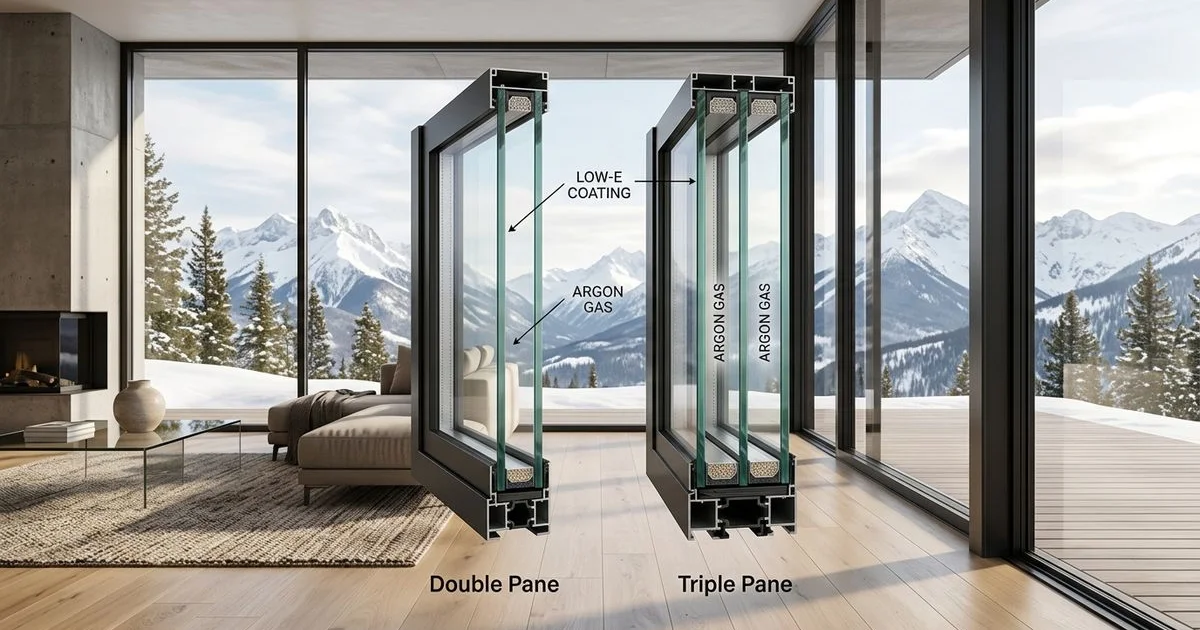
Double-pane insulated glass uses two panes of glass with a sealed cavity between them, typically filled with argon gas. Low-E coating is applied to one interior surface (usually surface #2 — the interior side of the exterior pane).
Triple-pane insulated glass uses three panes of glass with two sealed cavities between them, typically both filled with argon. Low-E coatings are applied to two interior surfaces (typically surfaces #2 and #5 — one on each interior IGU face).
Thermal Performance
- Double-pane low-E argon: Center-of-glass U-factor approximately 0.24-0.28
- Triple-pane low-E argon: Center-of-glass U-factor approximately 0.15-0.18
Triple-pane roughly halves the heat transfer through the glass. That’s a significant improvement, and it’s why triple-pane is standard on passive-house-grade specifications.
Weight
Triple-pane adds significant weight. A typical triple-pane IGU is approximately 50% heavier than the equivalent double-pane. On large-format architectural windows, that added weight affects the hardware capacity requirements, and on multi-panel sliding walls, it affects the track and rolling hardware selection.
Cost
Triple-pane costs 20-40% more than equivalent double-pane per square foot. On a large window package, the cost differential adds up.
When to Choose Each
Double-pane low-E argon is often the right choice for:
- Standard high-performance Colorado projects where IECC compliance is required but Passive House isn’t a target
- Non-mountain-county Colorado projects where energy code amendments don’t push U-factor below 0.28
- Openings where weight is a constraint (large sliding walls where triple-pane weight complicates the hardware)
- Value-optimized specifications where the marginal thermal benefit doesn’t justify the cost premium
Triple-pane is often the right choice for:
- Passive-house-grade specifications requiring U-factor 0.15 or below
- High-elevation extreme-cold Colorado projects (Aspen, Steamboat, Breckenridge, Telluride) where the thermal performance benefit is real
- Projects with mountain-county IECC amendments requiring extremely tight U-factor
- Comfort-priority specifications where the client values the frame-edge comfort of triple-pane over the cost
The design consultation walks through the choice against the project’s energy targets, budget, and design context.
Low-E Coating Types
Low-E coatings come in multiple varieties, each with different thermal and optical characteristics:
Hard-coat (pyrolytic) low-E. Applied during glass manufacture at high temperature. More durable, can be heat-treated and tempered. Generally slightly less thermally aggressive.
Soft-coat (sputtered) low-E. Applied after glass manufacture through vacuum sputtering. More thermally aggressive (better U-factor performance) but slightly less durable — usually protected inside the IGU cavity.
Solar-control low-E. Coatings tuned for specific SHGC targets — low-SHGC for cooling-dominated climates or west-facing exposures, higher-SHGC for passive-solar-gain applications.
For Colorado applications, soft-coat low-E is the standard specification because the thermal benefit is what matters most in a heating-dominated climate. Solar-control tuning is applied by orientation (see meeting IECC energy codes).
Argon vs. Krypton Fill
Argon gas is the standard fill for high-performance IGUs. It has thermal conductivity roughly 60% that of air, so replacing the air fill with argon significantly improves cavity thermal performance.
Krypton gas is used on specific applications — usually shallow-cavity IGUs where argon’s performance is compromised. Krypton has thermal conductivity roughly 40% that of air. It’s significantly more expensive than argon, so it’s used selectively where its performance justifies the cost.
For most Colorado specifications, argon is the fill. For thin-cavity specialty specifications, krypton may be considered.
Altitude-Specific IGU Considerations
At Colorado altitudes above about 5,000 feet, the pressure differential between the IGU’s sea-level-manufactured internal pressure and the site’s atmospheric pressure stresses the edge seals. Without altitude-specific detailing, this stress causes long-term seal failure.
Alta Vetro’s specification uses capillary breather tubes on IGUs installed at altitude (see high-altitude glazing physics). The tubes equalize internal pressure during transport, and are sealed at the site’s ambient pressure once installed.
This is standard on altitude specifications, not an add-on. Every Alta Vetro glazing specification for a mountain-county project includes the altitude detail.
The Practical Recommendation
For most Colorado projects, the specification lands as follows:
- Front Range residential (Denver, Boulder, Cherry Hills): Double-pane low-E argon on most openings; triple-pane on specific high-performance targets
- Mountain-county residential (Vail, Aspen, Snowmass, Telluride, Steamboat): Triple-pane low-E argon on primary elevations; double-pane on interior or protected openings; capillary breather tubes standard
- Passive-house-grade projects: Triple-pane low-E argon with high-performance edge seals; airtight installation detailing
The design consultation covers the specific glazing selection alongside the frame and hardware specification. The architectural window hub walks the full product line, and the engineering windows for snow load, UV, and temperature swings guide covers the site-specific engineering details.
FAQ
Related Questions
Is triple-pane always better than double-pane?
No. Triple-pane improves thermal insulation but adds glass weight, hardware demand, and cost. The right choice depends on the project's energy targets, the specific opening, and the site conditions. Standard high-performance projects often specify double-pane; passive-house-grade or extreme-cold projects specify triple-pane.
What does low-E do?
Low-E (low emissivity) coatings reduce heat transfer through the glass by reflecting long-wavelength thermal energy. On the interior surface of the exterior pane, low-E reflects interior heat back into the room in winter. It also controls solar gain — the coating specification is tuned to admit or reject solar heat by orientation.
Does altitude affect the IGU?
Yes. Insulated glass units sealed at sea-level pressure face significant pressure differentials at Colorado elevations. Capillary breather tubes on IGUs specified for altitude prevent the pressure differential from stressing the edge seals. This is standard on Alta Vetro high-altitude specifications.
Continue Reading
Related Guides
definition
Casement and Crank-Out Aluminum Windows Explained
How casement and crank-out aluminum windows work — operation, sealing, ventilation, narrow-frame aesthetics, and where they fit in modern homes.
scenario
Engineering Windows for Snow Load, UV, and Temperature Swings
How windows are engineered for Colorado — snow-load resistance, high-altitude UV protection, temperature-swing performance, and capillary breather tubes.
definition
Passive-House-Grade Windows for Colorado Mountain Homes
Passive-house-grade window performance for Colorado — thermal break, multi-cavity insulation, energy efficiency in extreme climates, and condensation resistance.
The Collection
Learn more about Architectural Windows
Explore the full product line and request a design consultation to translate this reading into a specification for your project.