Guides · scenario
Engineering Windows for Snow Load, UV, and Temperature Swings
How windows are engineered for Colorado — snow-load resistance, high-altitude UV protection, temperature-swing performance, and capillary breather tubes.
Updated July 17, 2026
The Mountain Is an Engineering Constraint
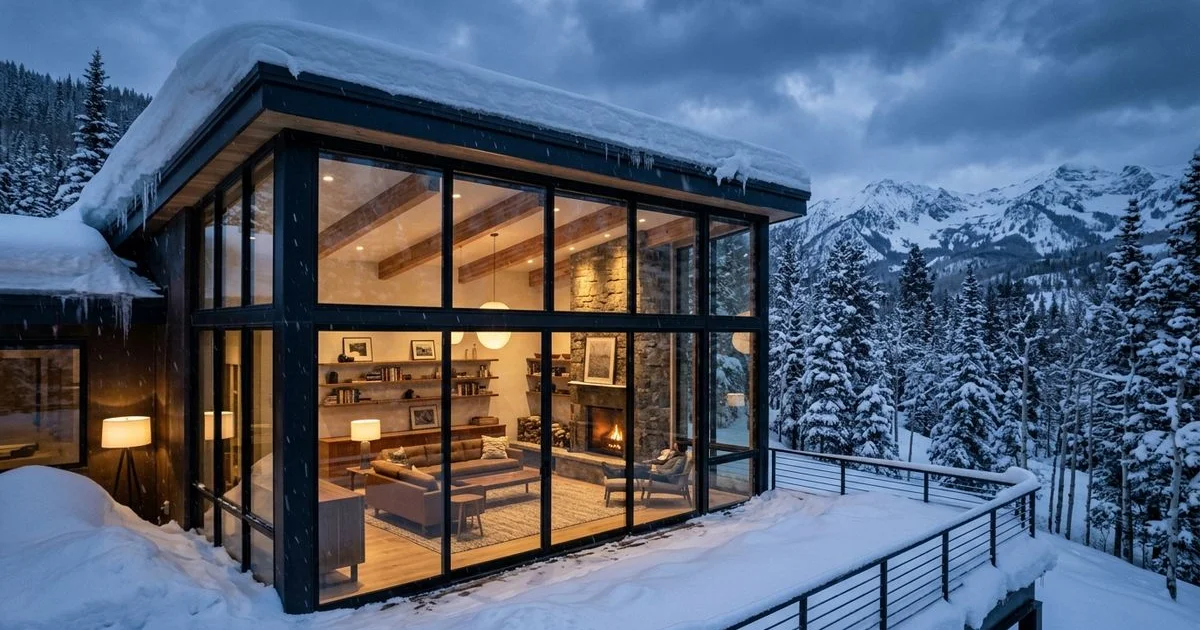
Every window on a Colorado mountain build has to be engineered for the site. The frame has to hold up under snow accumulation and wind. The glass has to survive the trip from a sea-level manufacturer to 9,000 feet without stressing the edge seal. The finishes have to hold their tone under altitude UV. The seals have to cycle across freezing daily for years without cracking or hardening.
Standard commodity windows aren’t engineered for these conditions. The Alta Vetro architectural window line is. Here’s what the specification actually addresses.
Snow-Load Resistance
Windows on mountain-home elevations face snow load in two ways:
Static snow accumulation on the sill. In sustained-snow conditions, snow accumulates on the exterior sill of the window until it either melts, blows off, or is knocked off by the resident. The sill construction has to hold the weight without deforming — and, more importantly, the drainage detail has to move the resulting meltwater away from the assembly before it can enter the frame or freeze back into a wedge that stresses the seal.
Dynamic snow-load transfer through the wall assembly. In sustained-heavy-snow winter conditions, the wall assembly itself may see additional lateral loading from snow accumulation on roof overhangs and against the wall. The window frame connection into the wall has to accommodate this loading without transferring stress into the sash or the glass.
Alta Vetro window construction includes reinforced sill assemblies for exposed installations and integrated drainage details that manage sill snowmelt. Framing detail integration into the wall assembly follows the specification package instructions.
High-Altitude UV
Colorado altitude means the atmosphere has less UV-attenuating mass than at sea level. UV intensity at 9,000 feet can be 40-50% higher than at sea level on the same solar angle. That intensity acts on three window components:
Finishes. Powder-coat and anodized finishes on the frame need to be UV-durable at altitude. Standard commodity powder-coat finishes chalk, oxidize, or fade unevenly after a few years at Colorado elevations. Alta Vetro finishes are specified for altitude UV — the palette is qualified for mountain applications.
Glass coatings. Low-E coatings on the insulated glass units need to be UV-durable. Sputtered low-E coatings and soft-coat low-E surfaces are engineered for long-term UV durability; the specification confirms coating type is appropriate for altitude.
Gaskets and seals. Elastomer seals in the frame perimeter and around the IGU need to be UV-durable EPDM or similar elastomer compounds. Standard commodity gaskets can crack or harden after a few years of altitude UV exposure. Alta Vetro seals are specified for UV durability.
These are quiet specification details. They don’t show up in daily use in the first few years. They show up at year seven, when finishes are still holding, coatings are still performing, and seals are still flexible.
Extreme Temperature-Swing Performance
Colorado’s mountain climate doesn’t just get cold. It cycles. A January afternoon can put a south-facing window at surface temperatures above freezing; the January morning after it can put the same window at –15°F. That cycling — sometimes daily, sometimes multiple times a day — stresses every joint, seal, and interface in the window.
The Alta Vetro specification addresses temperature-swing performance through:
Thermally broken frame construction. The polyamide thermal break stops thermal bridging (see thermally broken aluminum guide) and damps the temperature swing on the interior frame face. The interior face doesn’t cycle as violently as the exterior face, and the polyamide strut absorbs the differential without transferring mechanical stress.
Freeze-thaw-durable seal materials. Seals hold flexibility at –20°F and compression at +85°F. The material specification is engineered for the cycle, not for steady-state cold.
Precision frame tolerances. Sash-to-frame tolerances are held tight through the operating temperature range. Sashes don’t bind at –10°F or hang loose at +85°F — the tolerance is designed for the cycle. This matters most on operable units; the casement and crank-out aluminum windows rely on that precision to seal repeatedly through the freeze-thaw season.
Capillary Breather Tubes for Altitude
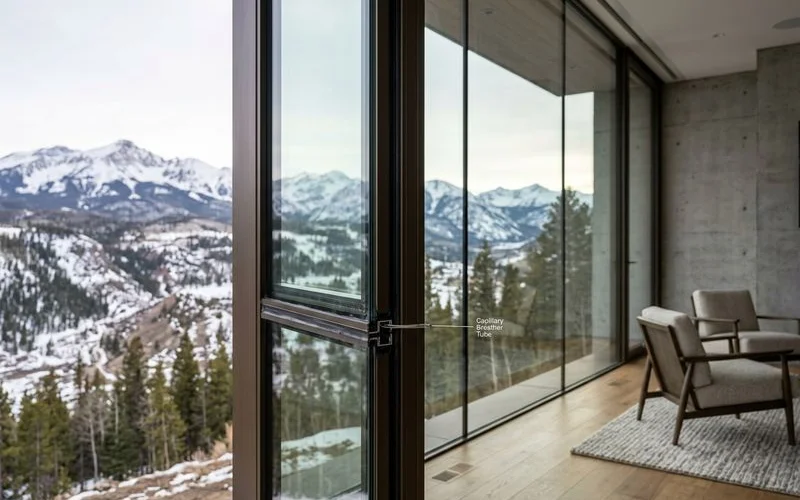
Insulated glass units sealed at sea-level pressure face significant pressure differentials when installed at Colorado elevations. Without pressure equalization, the IGU seals experience continuous mechanical stress that eventually causes failure.
Alta Vetro IGUs for installations above about 5,000 feet are specified with capillary breather tubes (see high-altitude glazing physics). The breather tubes allow the internal cavity to equalize with the outside atmosphere during transport, and are sealed at the installation site’s ambient pressure once the unit is in place.
This is standard on altitude installations, not an add-on. The architectural window hub covers the altitude specification defaults.
Whole-Site Engineering
For a specific Colorado project, the design consultation walks through the site conditions:
- Elevation — determines IGU altitude specification, framing thermal targets
- Exposure — orientation, wind exposure, snow drift patterns
- Design language — narrow-frame vs. standard, casement vs. fixed
- Energy targets — IECC code, county amendments, Passive House if applicable
From these, the window specification is configured. Standard configurations already address altitude, UV, freeze-thaw, and snow-load resistance. Custom configurations may adjust for extreme conditions.
What This Delivers
For a Colorado mountain-home client, the engineering specification means windows that continue performing — thermally, structurally, aesthetically — at year fifteen the way they performed at year one. The specification decisions are quiet, but the outcomes are direct: no fogged IGUs, no chalked finishes, no cracked seals, no drafts at the frame edge. The mountain doesn’t take a toll on the windows because the windows were engineered for the mountain from the start.
FAQ
Related Questions
Do windows handle snow load?
Yes. Frames and glass are engineered for snow-load and structural demands typical of Colorado sites. Sill construction accommodates snow-drift accumulation without deforming the assembly.
Is UV a concern at altitude?
Yes. High-altitude UV is significantly more intense than at sea level. Glass coatings, finishes, and gasket materials are specified for altitude-appropriate durability.
Why capillary breather tubes?
They equalize the internal pressure of insulated glass units so the units survive the pressure differential between sea-level manufacture and mountain-elevation installation. Without them, the IGU edge seal is stressed and eventually fails.
Continue Reading
Related Guides
definition
Casement and Crank-Out Aluminum Windows Explained
How casement and crank-out aluminum windows work — operation, sealing, ventilation, narrow-frame aesthetics, and where they fit in modern homes.
comparison
Double vs. Triple-Pane and Low-E Glass for High-Altitude Homes
Choose glazing for mountain performance — double vs triple-pane trade-offs, low-E coatings, argon fill, U-factor/SHGC, and altitude-specific IGU considerations.
definition
Passive-House-Grade Windows for Colorado Mountain Homes
Passive-house-grade window performance for Colorado — thermal break, multi-cavity insulation, energy efficiency in extreme climates, and condensation resistance.
The Collection
Learn more about Architectural Windows
Explore the full product line and request a design consultation to translate this reading into a specification for your project.