Guides · definition
How Bi-Fold Door Systems Work
Bi-fold mechanics explained — folding panel operation, top-hung and bottom-rolling systems, thermal insulation, and track and screen integration.
Updated July 17, 2026
The Folding Mechanism, Explained
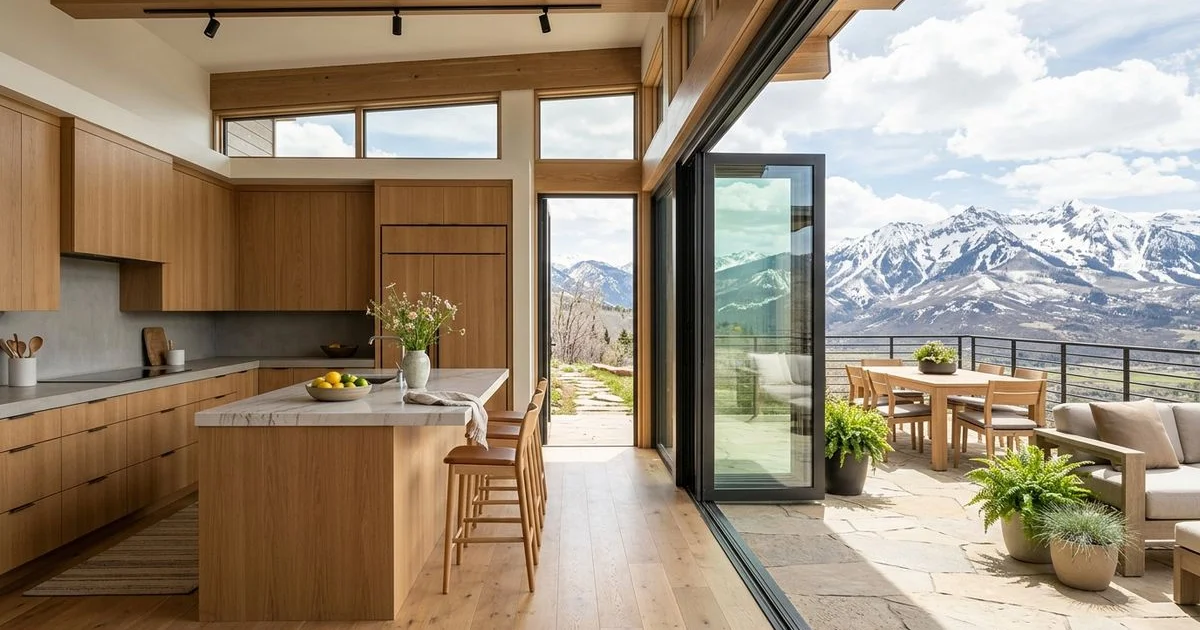
A bi-fold door isn’t a single panel that swings or a set of panels that slide. It is a series of glass panels connected by hinges in pairs, so that when opened, each pair folds together like an accordion. The folded stack sits perpendicular to the wall plane, leaving the opening 100% clear.
Alta Vetro’s bi-fold system makes that mechanism perform on a Colorado mountain build. Here’s how the mechanics actually work.
Panel Pairing and Fold Direction
Bi-fold configurations always come in even panel counts on each side of the opening. A six-panel bi-fold folds three panels to each side (or all six to one side). An eight-panel bi-fold folds four to each side (or all eight to one side).
Each panel pair is connected by a hinge running the full height of the panel edge. When the pair folds, the two panels rotate around their shared hinge. Adjacent pairs are also hinged together, so the whole run folds sequentially — the first pair folds, then pulls the second pair into its fold, then the third, and so on until the whole stack is against the jamb.
The stack sits perpendicular to the wall plane. On a six-panel bi-fold with all-to-one-side configuration, the stack projects about 5-6 inches from the wall on the fold side (three panel thicknesses plus hinge hardware). On split configurations with panels folding to both sides, the projection is half that per side.
Top-Hung vs. Bottom-Rolling
Two hardware configurations serve different applications:
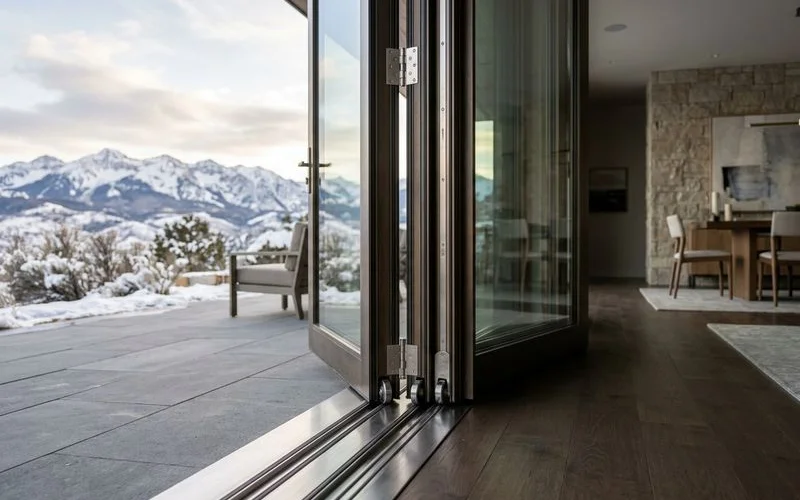
Top-hung bi-fold suspends the panels from a load-bearing head track. Rollers or trolleys on each panel run in the head track and carry the panel weight. The sill track is a light guide track — it prevents lateral movement but doesn’t carry weight. Top-hung is often preferred where the sill floor detail is critical (barrier-free thresholds), because the sill hardware is minimized.
Bottom-rolling bi-fold rolls on stainless steel pulleys and tracks at the sill. The head track is a guide track — it prevents lateral movement but doesn’t carry weight. Bottom-rolling systems are often specified where head-track structural loading is a concern (e.g., where the header can’t cleanly carry panel weight), or where the sill construction accommodates the load-bearing hardware.
Both configurations are available on the Alta Vetro bi-fold line, and the specification confirms which is right for the specific opening context.
Thermal Insulation
A bi-fold’s thermal performance is critical because every panel intersection is a potential thermal weak point. The Alta Vetro bi-fold system uses:
- 95mm structural-depth thermally insulated aluminum profile — the deepest thermally broken frame in the line, which accommodates the multi-cavity insulation
- Polyamide thermal break at the frame perimeter
- Insulated glass units with low-E coatings and argon fill
- Anti-pinch double-layer gaskets at panel intersections — which serve dual purposes: safety at the pinch points during folding, and improved sealing at rest
Whole-assembly thermal performance to 0.34 W/m²K meets IECC energy code targets for mountain-county specifications when the glass is spec’d appropriately.
Track System
The tracks are precision engineering. On a bottom-rolling system, the stainless steel track is a machined channel with V-groove or flat profile depending on the pulley design. Stainless is specified because:
- Corrosion resistance at the exterior threshold, which sees water, snowmelt, and salt (from de-icing) throughout Colorado winters
- Wear resistance — the same track surface sees years of daily rolling without developing wear grooves that would compromise operation
- Dimensional stability across the operating temperature range
The four track options guide covers the specific track configurations, including ADA-compliant and barrier-free flat tracks.
Screen Integration
Retractable and pleated screens integrate with bi-fold openings. Two common configurations:
Retractable screen from the fold-side pocket. The screen retracts into a pocket at the fold-side jamb. When the bi-fold is closed, the screen deploys across the opening to catch insects while keeping the glass wall functional. When the bi-fold opens, the screen retracts.
Pleated screen door. A pleated screen mounted on its own track deploys and retracts independently of the bi-fold. Useful when the opening is used in “screen only, bi-fold open” mode frequently.
Both configurations preserve the closed-wall sightlines and disappear when not deployed.
Anti-Pinch Double Gaskets
The dual-layer gaskets at panel intersections are one of the underappreciated safety features of the Alta Vetro bi-fold. They:
- Compress at the pinch points during folding, so a hand or finger caught briefly at a hinge intersection is protected by the gasket compression
- Improve seal performance at rest by providing a redundant compression seal along each panel intersection
- Reduce noise during operation, dampening the sound of the panels meeting at their fold positions
These are small mechanical details that show up in daily-use experience over years.
When Bi-Fold Is the Right System
The bi-fold hub covers the specific applications where bi-fold is the recommendation. In general: openings where a fully-clear opening is the design goal, where pocket depth isn’t available for sliding pocket configurations, and where the closed-wall mullion articulation is compatible with the architectural language.
For openings where minimal-mullion sightlines are the priority, narrow-frame sliding may be the better answer. The comparison guide walks the choice.
FAQ
Related Questions
How do bi-fold doors open?
Panels are hinged in pairs. When opened, adjacent panels fold together like an accordion and stack against a fixed jamb panel to one or both sides. The full folded stack sits perpendicular to the wall plane.
Are they top-hung or bottom-rolling?
Both configurations are available. Top-hung systems suspend the panels from a load-bearing head track, with a light guide track at the sill. Bottom-rolling systems roll on stainless steel pulleys and tracks at the sill, with a guide track at the head. Each has specific use cases.
Can screens be integrated?
Yes. Retractable and pleated screens integrate with bi-fold openings and disappear into a pocket or header when not in use. They handle insect and light control without compromising the closed-panel sightlines.
Continue Reading
Related Guides
comparison
Bi-Fold Folding Walls vs. Sliding Systems for Your Opening
Weigh bi-fold against sliding for your opening — full-open clearance vs minimal sightlines, stacking, thermal and cost differences, and ideal openings.
concern
Bi-Fold Performance Ratings for Demanding Applications (CW-PG55)
The performance credibility to spec bi-folds on demanding projects — CW-PG55, wind load to 5,000 Pa, water tightness to 600 Pa, air tightness, hurricane pin option.
scenario
Floor-Track Options: ADA-Compliant, Barrier-Free, and Flat Tracks
Four bi-fold track options — ADA-compliant low-profile and barrier-free flat tracks with drainage integration, and when to choose each.
The Collection
Learn more about Folding / Bi-Fold Door Systems
Explore the full product line and request a design consultation to translate this reading into a specification for your project.