Guides · comparison
Lift & Slide vs. Multi-Track Sliding Systems
Choose the right sliding mechanism — operation and sealing differences, panoramic vs full-wall openings, weight handling, and when each fits.
Updated July 17, 2026

Two Mechanisms, Two Design Answers
The sliding glass systems offer two distinct mechanism families: lift & slide and multi-track sliding. Each answers a different design question, and choosing between them is one of the first specification decisions on a panoramic opening.
Here is how each mechanism works, and where each is at its best.
How Lift & Slide Works
A lift & slide door has two states. At rest — closed — the panel weight presses down onto compression seals along the sill and jamb. The seal is under full load; air and water tightness is at maximum.
To open, the user turns a handle 90 degrees. That handle motion mechanically lifts the panel off the seals by a small amount — typically 6 to 10 millimeters. The lift moves the load from the seals to a set of rolling carriages under the panel. The panel now glides on the carriages with almost no friction — a two-panel lift & slide moves 12 feet of glass with one hand.
To close, the user pushes the panel to its closed position and turns the handle 90 degrees back. The panel lowers onto the seals. The compression re-engages.
The mechanism combines two things that don’t normally coexist: effortless operation and firm seal compression.
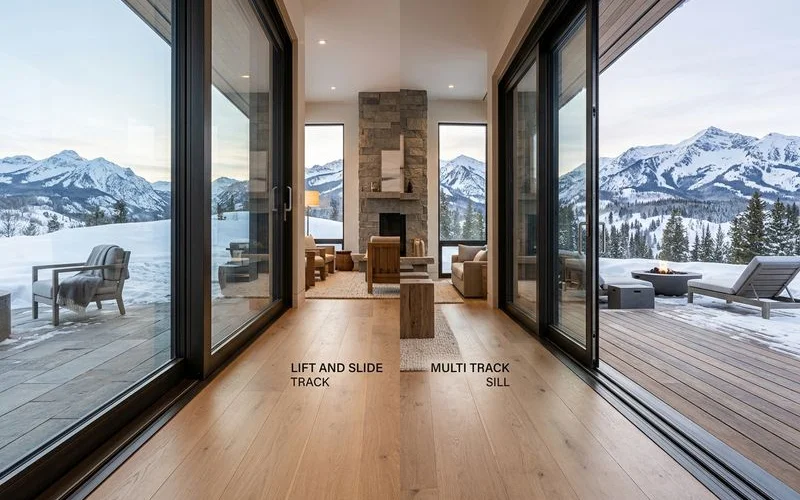
How Multi-Track Sliding Works
A multi-track sliding system uses multiple parallel tracks in the sill and head, with panels running on separate tracks. To open, panels slide sideways along their respective tracks and stack against a fixed panel or into a pocket. Multi-track configurations can open a much larger portion of the wall than a two-panel lift & slide — three panels stacking two-and-two, four panels stacking three-and-one, or pocket configurations that hide panels entirely inside the wall.
The tracks in a multi-track system are lower-profile than lift & slide (there is no lift mechanism to accommodate), which allows barrier-free flush thresholds with integrated drainage. Sealing is by continuous perimeter seals compressed by the panel’s own weight in the closed position, similar to lift & slide but without the active compression cycle.
When Each Is at Its Best
Lift & Slide is at its best when:
- The opening is a two-panel or three-panel configuration (typical widths 10-24 feet)
- Sealing performance in adverse weather is critical (high-wind exposure, driven rain, high-altitude cold)
- Effortless operation is a design priority — heavy panels moving on one-hand push
- The opening’s aesthetic favors clean sightlines with visible high-quality hardware
Multi-Track Sliding is at its best when:
- The opening is a full-wall or wide multi-panel configuration
- The opening wants to disappear entirely into a pocket, revealing a fully clear opening
- Barrier-free flush thresholds are critical for level indoor-outdoor transitions
- The opening’s aesthetic favors ultra-thin frame proportions with pocket concealment
Both mechanisms can hit the narrow-frame minimal-sightline aesthetic that drives premium sliding selection.
Cost and Configuration
Cost is per-specification, not per-mechanism. Lift & slide hardware is more mechanically complex per panel, but multi-track configurations often require more panels for equivalent opening width. The two systems land in comparable ranges when specified against the same opening.
The Design Consultation
For a specific opening, the choice between lift & slide and multi-track is walked through in the design consultation. Opening width, panel count, threshold detail preferences, and daily-use expectations all inform the recommendation.
For most 2-panel or 3-panel openings up to 24 feet wide, lift & slide is the recommendation. For full-wall pocketing configurations or 4+ panel walls, multi-track is often the mechanism. The specification lands with the mechanism confirmed against the architecture.
Read the sliding-glass systems hub for the full product line context.
FAQ
Related Questions
What is lift & slide?
A hardware mechanism that raises the panel off its seals to slide, then lowers it back down to compress the seals when closed. It gives effortless operation and full-perimeter compression seal in one system.
When is multi-track better?
For full-wall openings where multiple panels need to stack across multiple tracks. Multi-track configurations open a larger portion of the wall than a two-panel lift & slide can, and are the pattern for full-wall panoramic openings.
Which seals better?
Lift & slide compresses seals firmly under the panel's own weight when closed, so its sealing under most conditions is exceptional. Multi-track can achieve equivalent sealing with well-specified perimeter seals, but the lift-and-lower motion of lift & slide is what makes its seal compression particularly consistent.
Continue Reading
Related Guides
scenario
Flush Sills and Barrier-Free Thresholds for Indoor-Outdoor Living
How ADA-compliant flat tracks, integrated drainage, and flush sills blend indoor floor to outdoor patio while protecting against wind and water.
what to-expect
Meeting IECC Energy Codes with Expansive Moving Glass Walls
How large-format glass walls meet IECC U-factor and SHGC limits in Colorado mountain counties with low-E and insulated glass — without losing the view.
definition
Narrow-Frame Panoramic Sliding Doors and Minimal Sightlines
How narrow-frame construction and structural glazing maximize glass and minimize aluminum for the minimal-sightline sliding aesthetic.
process
Sizing and Structural Planning for Large Sliding Glass Walls
Plan an oversized sliding opening — panel weight limits to 45 kg/m², structural support, rough openings, and coordination with framing and installation.
The Collection
Learn more about Sliding Glass Door Systems
Explore the full product line and request a design consultation to translate this reading into a specification for your project.