Guides · process
Entry Door Finishes, Panel Styles, and Hardware Options
Walk the entry-door catalog — 40+ panel designs, 12 designer finishes plus custom colors, concealed vs exposed hinges, custom glass, and oversized options.
Updated July 17, 2026
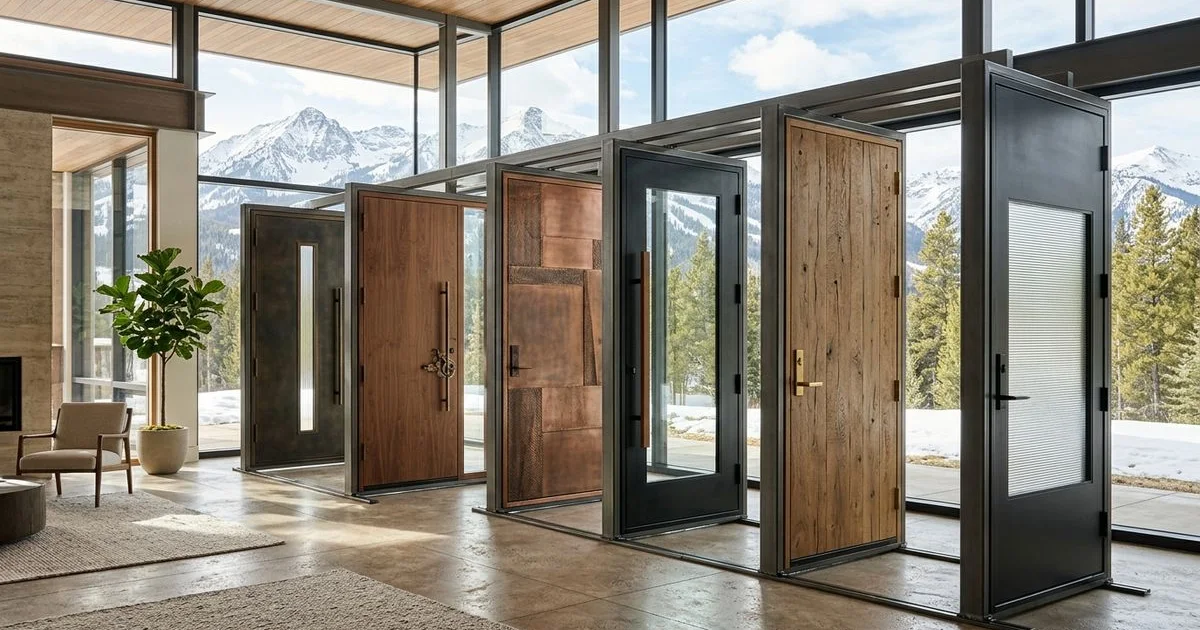
The Design Catalog, Organized
Choosing a premium entry door is choosing three things at once: the panel style, the finish, and the hardware. Each is configurable, and each contributes to the entrance’s architectural language.
The 40+ panel styles, 12+ designer finishes, and full hardware selection make the specification specific to the project rather than off-catalog. Here’s how the choices break down.
The 40+ Panel Design Styles
The entry-door line groups roughly into four families:
Flush minimalist. A single unbroken panel plane, no articulation, no rebate detail. Reads as sculpture. Ideal for contemporary modernist facades where any panel articulation would fight the design.
Linear-articulated modern. Horizontal or vertical banded articulation, subtle rebate lines, or minimalist geometric patterns. Reads mid-century modern or contemporary. Adds visual scale without breaking the modern language.
Sculpted contemporary. Panel contours, faceted planes, or textured surfaces that give the entrance sculptural presence. Reads editorial and design-forward. Common on statement entries.
Transitional / heritage-modern. Rebate detailing, raised panels with modern proportion, or design vocabularies that bridge traditional articulation and contemporary line quality. Reads warm-modern.
The design consultation walks through the panel style options against the architectural context of the project.
The 12+ Designer Finishes
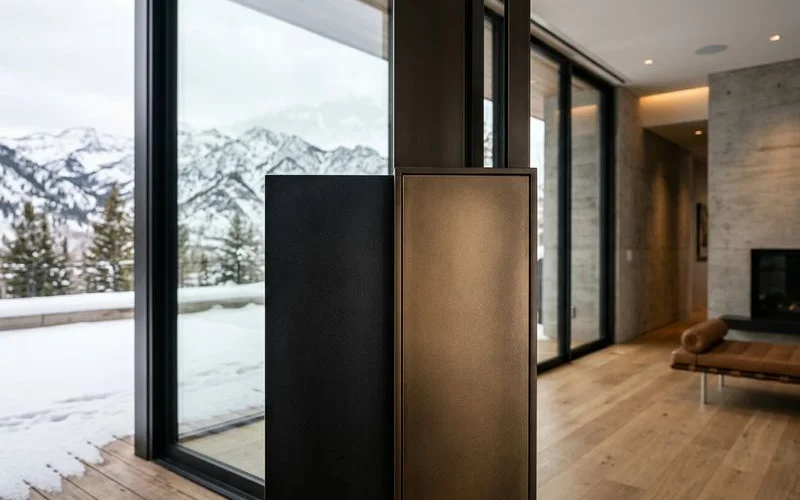
The standard finish palette covers most modern Colorado design decisions:
- Obsidian matte black — anchor finish, reads structural
- Graphite grey — softer than black, more warmth
- Metallic champagne — the brand signature, editorial and reflective
- Pearl bronze — warm neutral with quiet presence
- Deep bronze — mid-tone warmth for palettes needing depth
- Warm graphite — gray with warmth, works with wood palettes
- Wood-grain textures — oak-like, walnut-like, and additional wood-tone options with UV-durable altitude specification
- Pearl white and additional neutrals — for palettes where the door recedes
Custom colors are matched to RAL codes or the architect’s bespoke color, powder-coated or anodized to the same durability spec as the standard palette. The choosing finishes guide walks through the palette coordination across the project.
Concealed vs Exposed Hinges
Hinge selection is a subtle but important design decision.
Concealed 3D-adjustable hinges. Recessed into the door edge and jamb, invisible when the door is closed. Give the cleanest sightlines and the most minimalist reading. Standard on flush minimalist and sculpted contemporary panel styles.
Exposed 3D-adjustable hinges. Visible on the door edge, typically finished to match the door hardware. Give a more articulated reading with the mechanism as part of the composition. Common on transitional and heritage-modern panel styles.
Both hinge types are 3D-adjustable — vertical, horizontal, and rotational alignment can be tuned at install and re-tuned over the door’s life. The choice between concealed and exposed is aesthetic, not performance-related.
Multi-Point Locking (Standard)
Multi-point locking is standard across the entry line. When the door closes, multiple locking bolts engage at points around the panel perimeter — top, middle, bottom. This distributes the locked force across the door rather than concentrating it at a single latch, so the door pulls tighter to the seal and holds its plane against wind loading.
Smart-lock integration is available for keypad, biometric, or app-controlled entry systems that work with the multi-point mechanism. The specification confirms the integration for the chosen smart-lock brand. The security and multi-point locking guide covers how the locking system holds the panel to the seal and resists forced entry.
Custom Glass
Glass is available across the entry line — clear, fluted, reeded, bronzed, textured. On a solid-panel door, glass isn’t part of the specification. On a design with an integrated glass panel — sidelights, panel inserts, glazed transom — the choosing finishes guide covers the glass options in coordination with the panel style.
Insulated glass units in the door meet the same altitude-specific spec as the rest of the envelope (see the high-altitude glazing guide).
Oversized Configurations
Beyond standard entry dimensions, oversized configurations extend the panel size for statement entries. Oversized hinged entries — up to 4 feet wide, 10 feet tall in standard configurations — carry the same panel construction, finish, and hardware options. Beyond that scale, pivot doors become the mechanism, but the finish and design language coordinate across both.
How to Narrow
The catalog is broad by design. The narrowing happens in the design consultation, with the architecture, palette, and configuration all on the table. From there, panel style, finish, hinge type, locking, and glass become a specific configuration and the specification lands.
FAQ
Related Questions
How many panel styles are there?
Forty-plus panel designs run from flush minimalist through linear-articulated modern to sculpted contemporary, covering most modern and transitional architectural vocabularies.
Can hinges be hidden?
Yes. Both concealed and exposed 3D-adjustable hinges are available. Concealed hinges give the cleanest sightlines for minimalist facades; exposed hinges suit transitional and traditional design languages.
Are custom colors possible?
Yes. Beyond the 12 designer finishes, custom colors matched to RAL or a bespoke architectural palette are available, powder-coated or anodized to the same durability spec.
Continue Reading
Related Guides
comparison
Aluminum vs. Wood vs. Steel Luxury Entry Doors
Compare thermally broken aluminum against wood and steel luxury doors — longevity, thermal performance, warping resistance, design flexibility, and cost.
concern
Security and Multi-Point Locking on Luxury Aluminum Entry Doors
How multi-point locking, smart-lock integration, frame strength, and full-perimeter sealing secure high-value homes without sacrificing design.
definition
Thermally Broken Entry Door Construction Explained
Inside thermally broken entry doors — 86mm–100mm panels, multi-cavity frames, full perimeter sealing, and the thermal-break benefits at the front door.
The Collection
Learn more about Premium Entry Doors
Explore the full product line and request a design consultation to translate this reading into a specification for your project.