Guides · definition
Thermally Broken Entry Door Construction Explained
Inside thermally broken entry doors — 86mm–100mm panels, multi-cavity frames, full perimeter sealing, and the thermal-break benefits at the front door.
Updated July 17, 2026
What Sits Inside the Door Panel
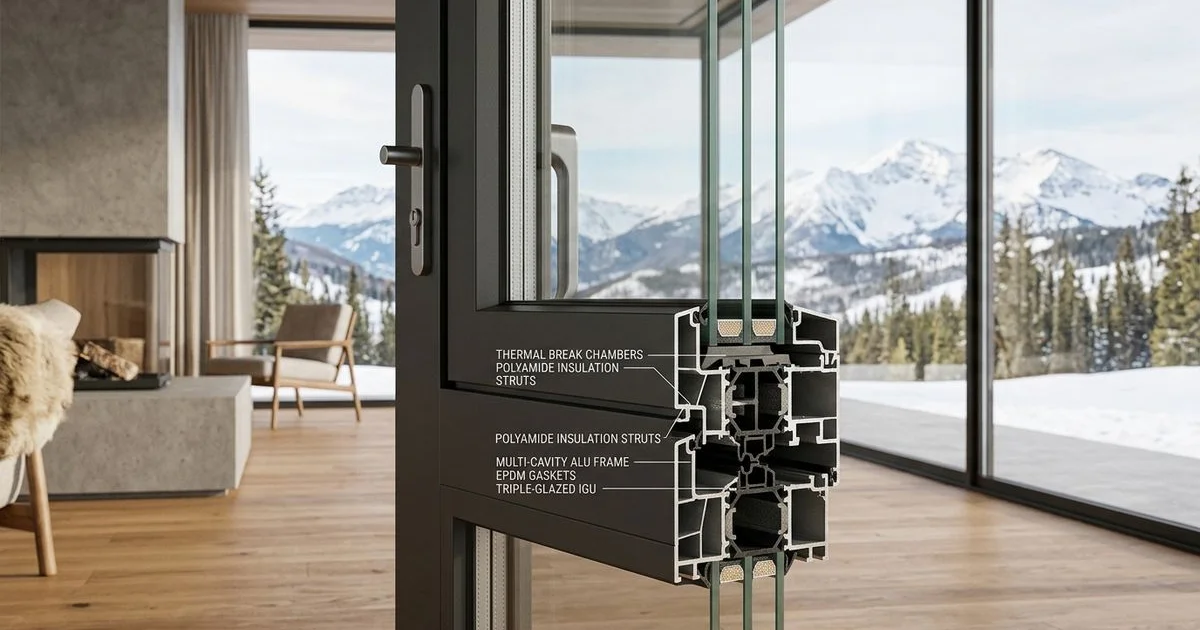
A thermally broken premium entry door looks, from a distance, like any other well-made aluminum entry door. Panel face, thin frame perimeter, discreet hardware. What makes it perform is what sits inside — multi-cavity frame construction, a polyamide thermal break, and full perimeter sealing that runs continuously around the assembly.
Alta Vetro premium entry doors are built on these fundamentals. Here’s how each part contributes — and why, in a Colorado climate, this construction is the reason aluminum outperforms wood and steel for a luxury entrance.
Panel Thickness: 86mm to 100mm
The panel is thicker than a commodity aluminum door because thickness is what accommodates the internal construction the panel needs to perform.
86mm is the standard series thickness — thick enough for multi-cavity construction, thermal break integration, and full-perimeter sealing without being so thick that the panel reads bulky. Most standard-scale premium entry configurations use 86mm.
100mm is the thermally broken oversized series — additional thickness for larger panel dimensions, more capacity for thermal break depth, and heavier hardware capacity. On oversized configurations or high-performance thermal targets, 100mm is the specification.
Both thicknesses read as slim from the exterior — the frame proportion doesn’t grow with panel thickness. The extra thickness lives inside the profile, doing thermal and structural work.
Multi-Cavity Frame Construction
Inside the aluminum frame profile, multiple internal chambers — cavities — serve distinct purposes:
Insulation cavities. The largest chambers, typically filled with foam insulation or left as air pockets, resist thermal transfer through the frame. Multi-cavity beats single-cavity because each cavity interrupts a potential thermal bridge and creates a more effective insulating profile.
Structural cavities. Smaller chambers with structural aluminum walls that carry the frame’s mechanical load. These distribute panel weight into the frame perimeter and resist deformation under wind loading.
Drainage cavities. Chambers routed to move any incidental moisture (from condensation on exterior faces, driven water past the primary seal, etc.) out of the assembly and away from the seal line before it can cause damage.
Wiring / conduit cavities (on select configurations). Chambers for routing smart-lock wiring, sensor cables, or LED accent lighting cleanly inside the frame.
That internal organization is what makes an 86mm or 100mm panel perform where a commodity 45mm aluminum panel would not. The thermally broken aluminum guide covers the underlying thermal principle.
Full Perimeter Sealing
Standard commodity aluminum doors seal at the top and sides. The bottom is typically an add-on threshold sweep, and the interface between the frame perimeter seal and the sweep is a common failure point.
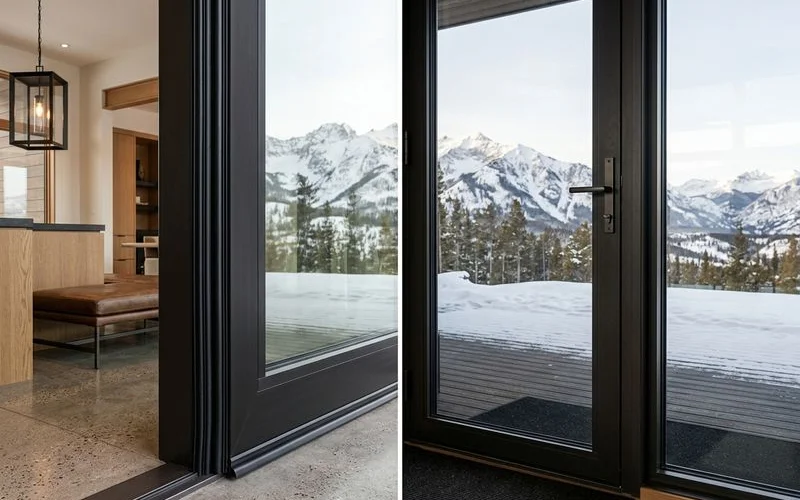
Alta Vetro entry doors run full perimeter sealing — a continuous elastomer compression seal around the entire door perimeter, top, sides, and bottom, with integrated corner detailing at each junction. When the door closes, the seal compresses under the multi-point locking force for consistent perimeter tightness.
Two consequences follow.
Air infiltration is dramatically reduced. Commodity doors leak air at their sealed corners and bottom threshold in ways the seal spec doesn’t fully address. Full perimeter sealing catches all four sides consistently, so the door’s whole-assembly air infiltration is measured as a full-perimeter system, not as a sum of independent seals.
Water tightness is preserved. On a Colorado entrance facing wind-driven snow or heavy rain, a bottom threshold weak point is where water gets in. Full perimeter sealing paired with integrated threshold drainage gives the assembly the ability to keep out driven water even under adverse exposure.
Where the Thermal Break Lives
The polyamide thermal break runs the length of the frame profile, sitting between the exterior and interior aluminum sections. On multi-cavity frames, the thermal break is integrated into the internal structure — the exterior chambers stay thermally isolated from the interior chambers, and the polyamide strut carries the mechanical load between them.
This is important because the location of the thermal break matters as much as its material. A break placed correctly — deep enough in the profile that it separates all thermally significant metal sections — delivers the whole-assembly performance. A break placed shallow or at the wrong depth leaves thermal bridges elsewhere in the profile. Alta Vetro’s frame profiles are engineered so the thermal break placement matches the multi-cavity structure.
What This Means for the Client
The construction detail is not something a homeowner sees. What they experience is the finished door. But the construction is what determines whether the finished door:
- Reads warm at the frame edge in January
- Doesn’t develop interior condensation
- Doesn’t leak air or driven water
- Holds its geometry and its seal for the door’s full life
- Meets the IECC energy code the architect specified against
Every one of those experience-level outcomes traces back to the multi-cavity, thermally broken, full-perimeter-sealed construction inside the panel. It is why premium entry doors read as premium in daily use — not just in the finished aesthetic.
FAQ
Related Questions
How thick are the panels?
Panel thicknesses run from 86mm on the standard series to 100mm on the thermally broken and oversized configurations. The thickness accommodates multi-cavity frame construction and full perimeter sealing.
What is multi-cavity construction?
Multiple internal chambers inside the aluminum frame profile that improve insulation, structural rigidity, and drainage handling. Each cavity serves a specific purpose — insulation, structural, or drainage — in the overall frame performance.
Why does perimeter sealing matter?
Full perimeter sealing runs a continuous elastomer compression seal around the entire door perimeter. It blocks air and water infiltration around the whole door, not just at the top and sides. On a Colorado entry, that continuous seal is what keeps drafts and driven water out.
Continue Reading
Related Guides
comparison
Aluminum vs. Wood vs. Steel Luxury Entry Doors
Compare thermally broken aluminum against wood and steel luxury doors — longevity, thermal performance, warping resistance, design flexibility, and cost.
process
Entry Door Finishes, Panel Styles, and Hardware Options
Walk the entry-door catalog — 40+ panel designs, 12 designer finishes plus custom colors, concealed vs exposed hinges, custom glass, and oversized options.
concern
Security and Multi-Point Locking on Luxury Aluminum Entry Doors
How multi-point locking, smart-lock integration, frame strength, and full-perimeter sealing secure high-value homes without sacrificing design.
The Collection
Learn more about Premium Entry Doors
Explore the full product line and request a design consultation to translate this reading into a specification for your project.